How to Convert Hours and Minutes to Decimal Hours
Convert minutes into decimal hours correctly, with a simple formula and examples such as 15 minutes = 0.25 h and 30 minutes = 0.5 h.
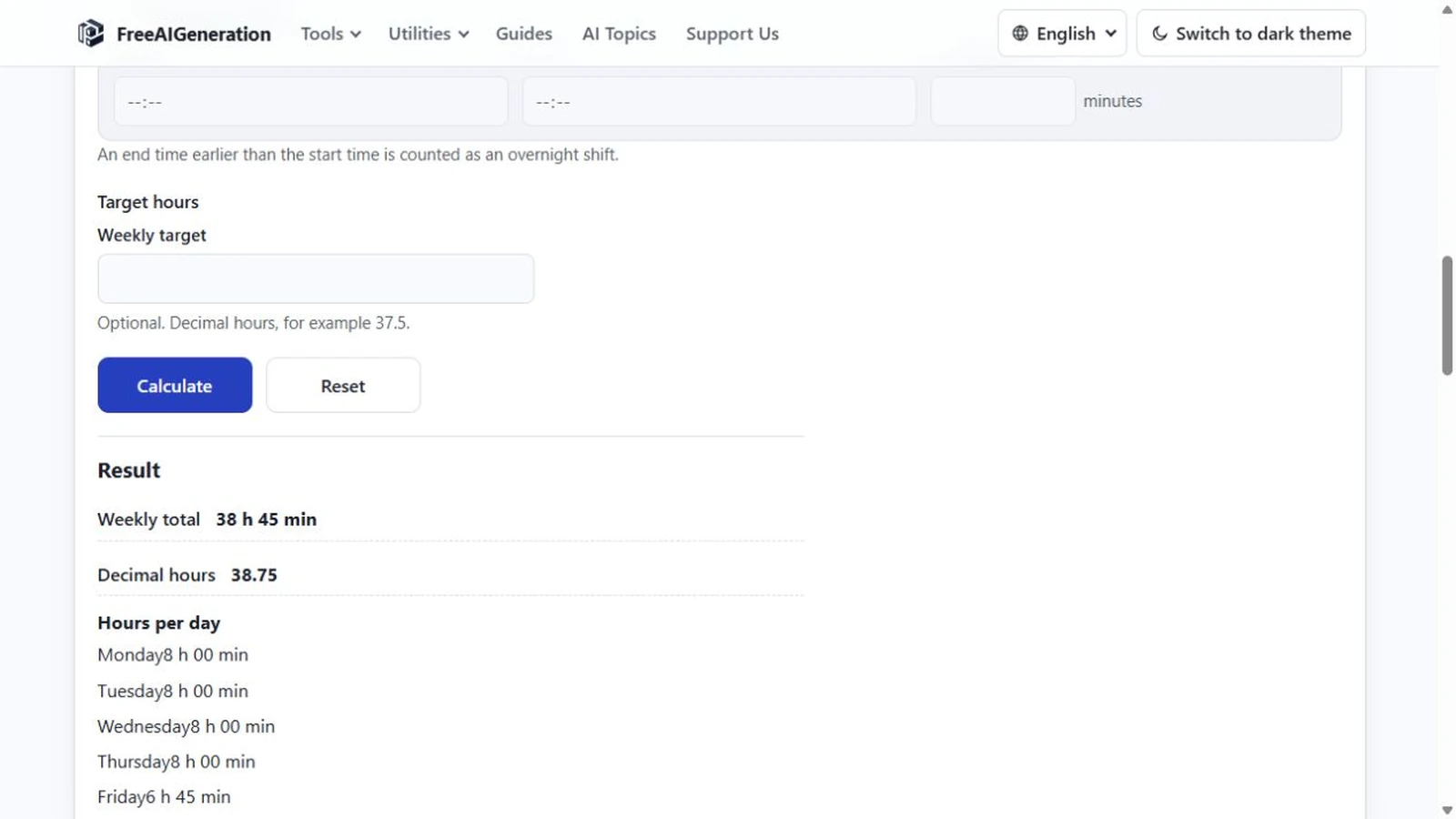
To convert hours and minutes to decimal hours, divide the minutes by 60. Fifteen minutes is 0.25, thirty is 0.5, forty-five is 0.75. The whole method is that one division; the part people get wrong is where the rounding happens and how many places it keeps.
The division, and the two-decimal step
Minutes ÷ 60 gives decimal hours directly. The work hours calculator does the same thing with an explicit rounding rule: it multiplies the minute total by 100, divides by 60, rounds to a whole number, then divides by 100. Written out, that is round(minutes × 100 / 60) / 100, applied once to the final total.
Multiplying before rounding keeps two decimal places of precision rather than one. It also fixes the order of operations: the decimal column is a rounded view of an exact minute figure, not a second independent calculation that could drift away from the first.
Minutes to decimal hours
| Minutes | Decimal hours |
|---|---|
| 6 | 0.10 |
| 15 | 0.25 |
| 20 | 0.33 |
| 30 | 0.50 |
| 45 | 0.75 |
Six minutes is a tenth of an hour, which is the smallest tidy fraction most schedules use. Below that, the two-decimal column begins rounding, and the h:mm column is the one to read.
Three conversions worked out
7 hours 40 minutes is 460 minutes. 460 × 100 / 60 = 766.67, rounded to 767, so decimal hours are 7.67 and the h:mm display is 7:40.
40 hours 30 minutes is 2,430 minutes. 2,430 × 100 / 60 = 4,050 exactly, so decimal hours are 40.5 and the display is 40:30.
Seven separate entries of one minute total 7 minutes. 7 × 100 / 60 = 11.67, rounded to 12, so the decimal column reads 0.12 while the h:mm column still holds the exact seven minutes. Both describe the same total, one of them through a rounding step.
Round once, at the end
A two-decimal figure loses up to about a third of a minute per total. That is harmless on a single line; applied to each day of a week and then summed, it accumulates into a figure that matches neither the minutes nor the h:mm column. This is why the calculator sums integer minutes first and converts the sum: five days of 7 hours 40 minutes is 2,300 minutes, which reads 38.33 decimal hours, not the 38.35 you get by adding five rounded 7.67 values.
The second failure is a notation error wearing the same clothes. 7.30 in a decimal field means 7 hours 18 minutes, since 0.30 × 60 = 18 — not 7 hours 30 minutes. The 12-minute difference and the reasons behind it are the subject of is 7 hours 30 minutes 7.30 or 7.5 hours?.
What the page does not do
The conversion runs one way only. The page starts from clock times and produces both displays; it will not take an arbitrary decimal and turn it back into h:mm. There is no sub-minute precision, no time-zone or calendar handling, and no rounding policy beyond the single two-decimal step — how a payroll system treats a partial hour after that is a separate rule.
Applying the conversion inside a record, where one rounded line can disagree with a weekly total, is covered in how to fill in a timesheet without calculation errors.
The Work Hours Calculator prints both columns for whatever clock times you enter. It runs in your browser, no FreeAIGeneration account required. Adjacent conversion and time guides sit in the guides hub.
Frequently asked questions
Is 30 minutes 0.30 or 0.5 decimal hours?
It is 0.5, because 30 minutes is half of 60. Writing 0.30 would mean 18 minutes instead.
Why does the decimal column sometimes disagree with the h:mm column?
The h:mm figure is exact and the decimal figure is rounded to two places, so the two differ only by that rounding; both come from the same minute total.
Can the calculator turn 7.67 back into hours and minutes?
No. It converts from clock times into both displays, and it does not accept a decimal hours value as a time input.
Related articles
-
7h30 vs 7.5 Hours: How Decimal Time Really Works
Understand why 7 hours 30 minutes equals 7.5 decimal hours, not 7.30, and learn the simple formula for converting minutes.
Utilities & productivity Date & time Calculators Converters 3 min read
Published By Julia M. Gil
-
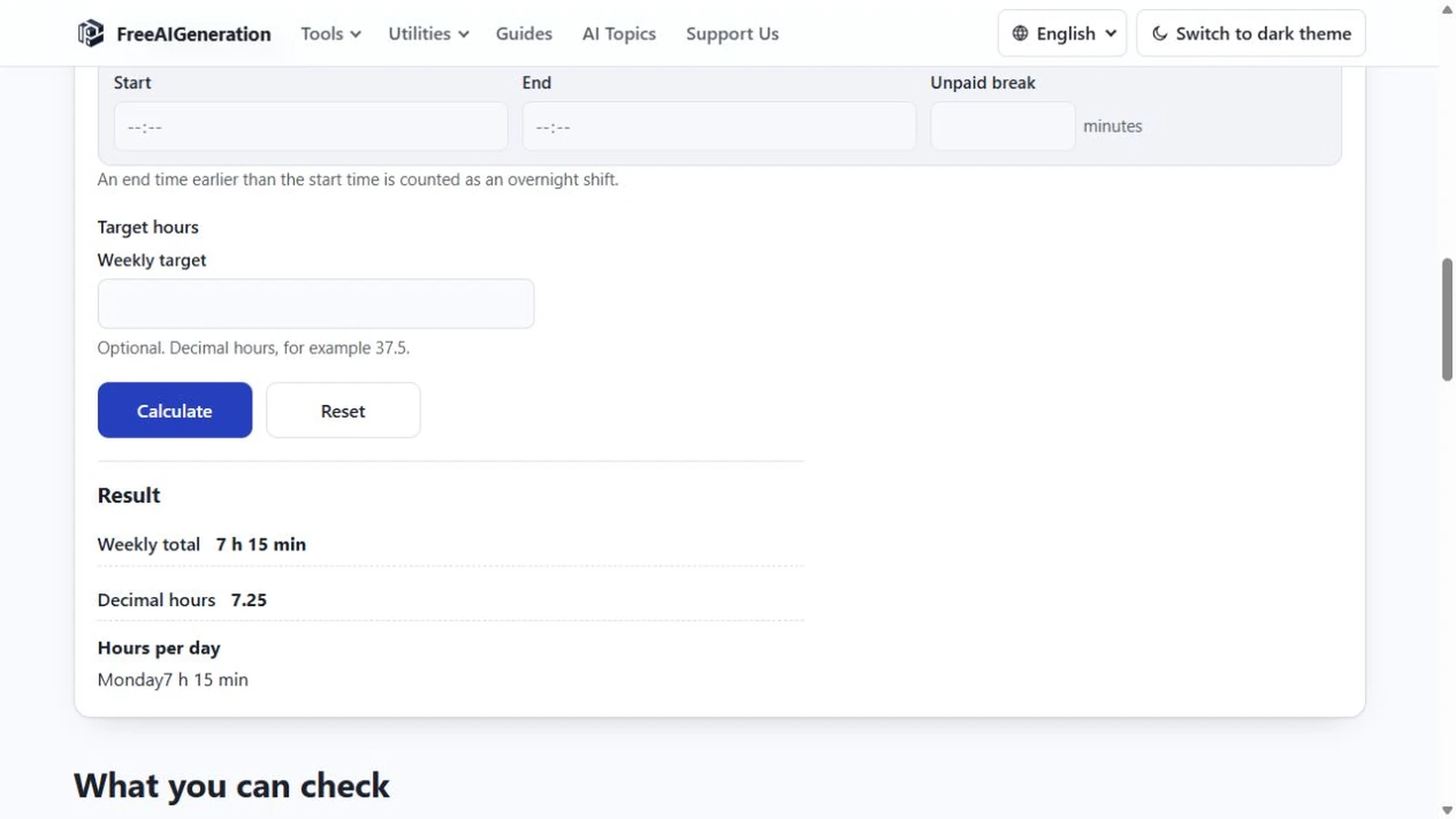
How to Calculate Work Hours in a Day
Calculate total worked time from a start time and end time, then subtract breaks accurately with simple examples and a free calculator.
Utilities & productivity Date & time Calculators Converters 3 min read
Published By Julia M. Gil
-
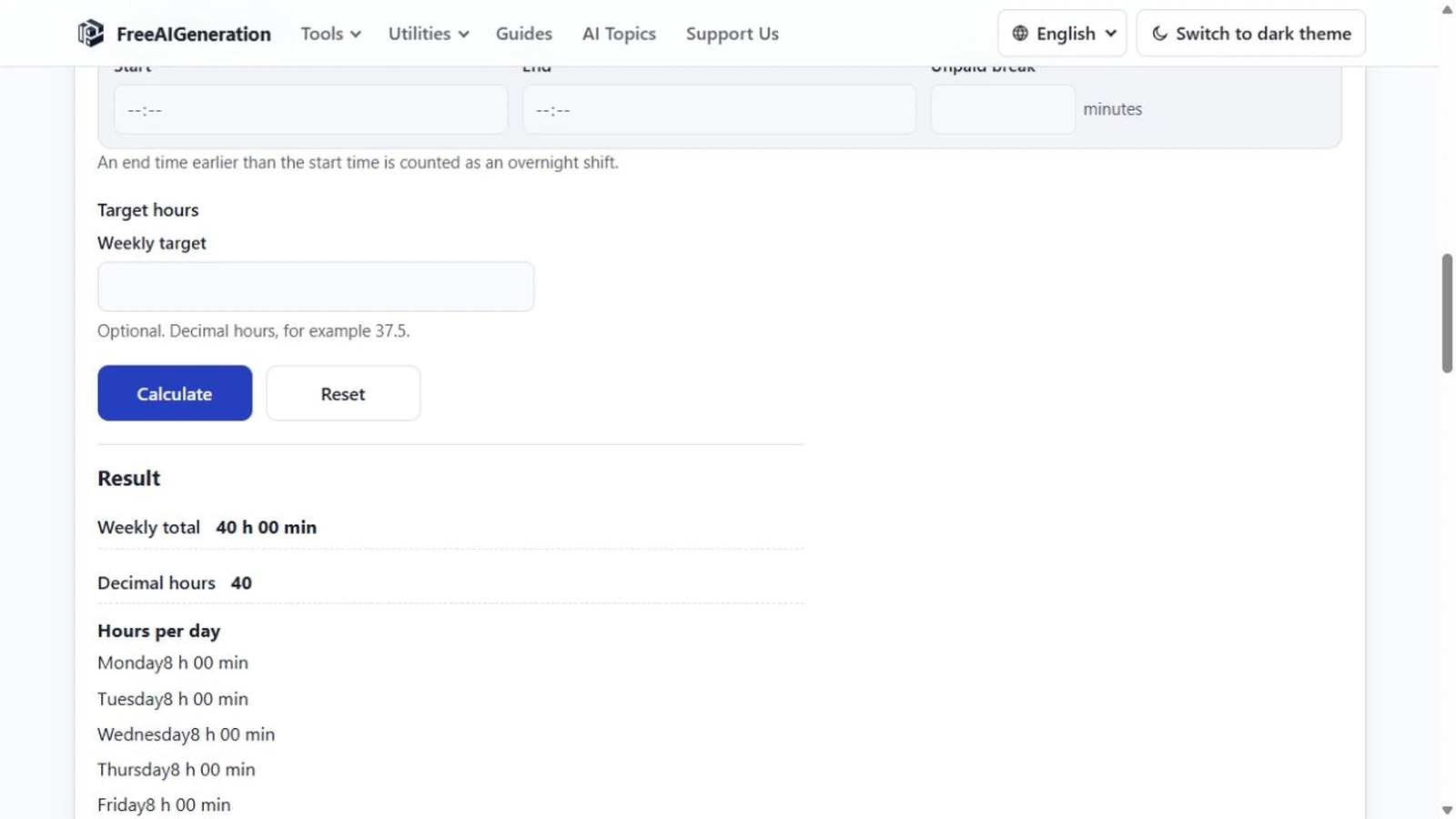
How to Calculate Work Hours with a Lunch Break
Take the shift span, then subtract the minutes you were not working; the traps are units and the size of the break. Overnight shifts work the same way.
Utilities & productivity Date & time Calculators Converters 3 min read
Published By Julia M. Gil
Keep exploring
FreeAIGeneration is more than this article. The editors and calculators below are real, free and run in your browser.