What Date Will It Be in 60, 90 or 100 Days?
Find the date 60, 90 or 100 days after a starting date and calculate any custom day interval with our free date tool.
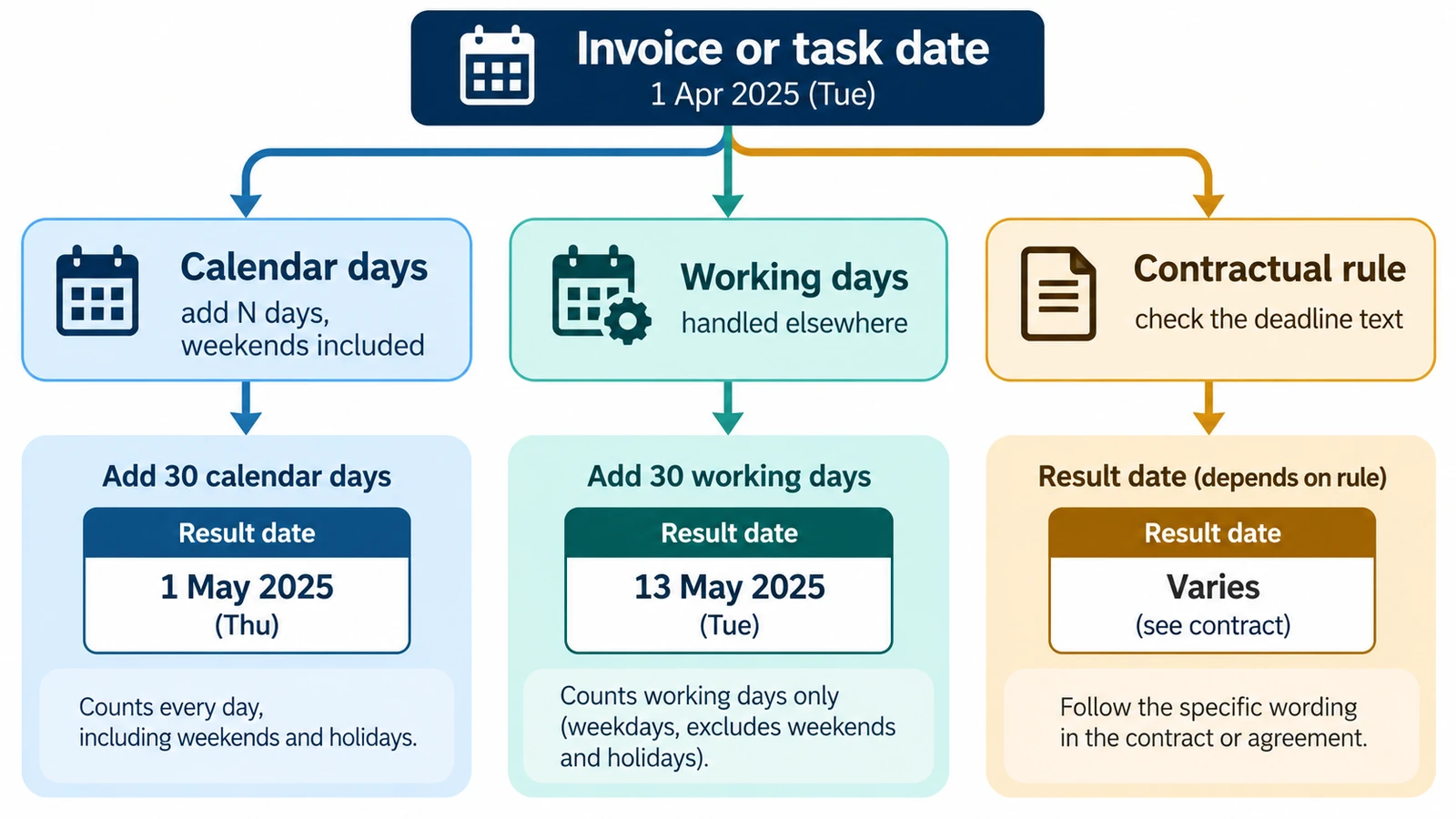
Ninety days sounds like a quarter. It is not one. The date in 90 days from a chosen start is exact calendar arithmetic, while a quarter is three calendar months and can span anything from 89 to 92 days.
The same page answers the 60-day and 100-day questions, because all three are ordinary counts typed into the same field. What changes is the arithmetic of the weekday and, occasionally, the leap year the count crosses.
Three counts, three answers
Starting from 22 October 2026, a Thursday:
| Count | Resulting date | Weekday |
|---|---|---|
| 60 days | 21 December 2026 | Monday |
| 90 days | 20 January 2027 | Wednesday |
| 100 days | 30 January 2027 | Saturday |
Each row is the start date plus that number of whole calendar days. The 90-day figure is the one most often mistaken for a quarter, and 20 January 2027 is two days earlier than the three-month date of 22 January.
What each count does to the weekday
Weeks are the quick way to check a weekday. Sixty days is eight weeks and four days, so the weekday advances by four: Thursday to Monday. Ninety days is twelve weeks and six days, so it advances by six: Thursday to Wednesday. One hundred days is fourteen weeks and two days, so it advances by two: Thursday to Saturday.
The remainders are the whole story. Every complete week returns to the same weekday, and only the leftover days move it.
That also means counts seven days apart land on the same weekday. Sixty-three days from a Thursday is a Thursday, and so is seventy days.
The quarter illusion
A quarter means three calendar months, and three calendar months are not a fixed number of days. From 1 January 2024, three months later is 1 April, which is 91 days after the start. The 90-day count lands on 31 March 2024, a Sunday.
The gap depends on which months you cross. Between 22 October 2026 and 22 January 2027 the span is 92 days, so a 90-day count stops two days short. Counts that cross a February differ most: a common-year quarter from 1 February to 1 May is 89 days, so a 90-day count there lands one day after the three-month date.
If a document says “90 days”, do not substitute a quarter, and if it says “one quarter”, do not substitute 90 days. The two phrases are close enough to seem interchangeable and far enough apart to move a deadline.
When a leap day falls inside the span
A leap day adds one date to the year, so a count that crosses 29 February can land a day earlier than the same count from the same date in a common year.
From 1 January 2024, 90 days later is 31 March. From 1 January 2023, 90 days later is 1 April. Same start date, same count, different answer by one day, because 2024 has a 29 February inside the span.
The effect appears from February starts as well. From 1 February 2024, 90 days later is 1 May; from 1 February 2023, 90 days later is 2 May. The leap day is the only variable, and it is fixed in advance.
Typing any count you need
60, 90 and 100 are ordinary counts with no shortcuts. Type the start date and the count in the Add or Subtract Days Calculator with the add direction selected, and the result appears as a date, a weekday and a summary sentence.
The count field takes one to nine digits — whole days only — and a count large enough to leave the supported years 0001 to 9999 returns an out-of-range message rather than a wrapped date.
The calculator runs in the browser tab and needs no FreeAIGeneration account. It keeps no history, so record the result if it is going into a document.
For the shorter horizon, the 30-day date has its own guide. When the count is a term added to a start date to produce a deadline, calculating a due date is the closer framing.
Frequently asked questions
Is 90 days the same as a quarter?
No. Three calendar months span 89 to 92 days, so the 90-day date and the three-month date can land a day or two apart.
Are there shortcut buttons for 60, 90 or 100 days?
No. Each is an ordinary whole-day count typed into the count field with the add direction selected.
Why does a 90-day count move the weekday by six days?
Ninety days is twelve whole weeks plus six days; twelve weeks return to the same weekday, so the remaining six move it forward by six.
Related articles
-
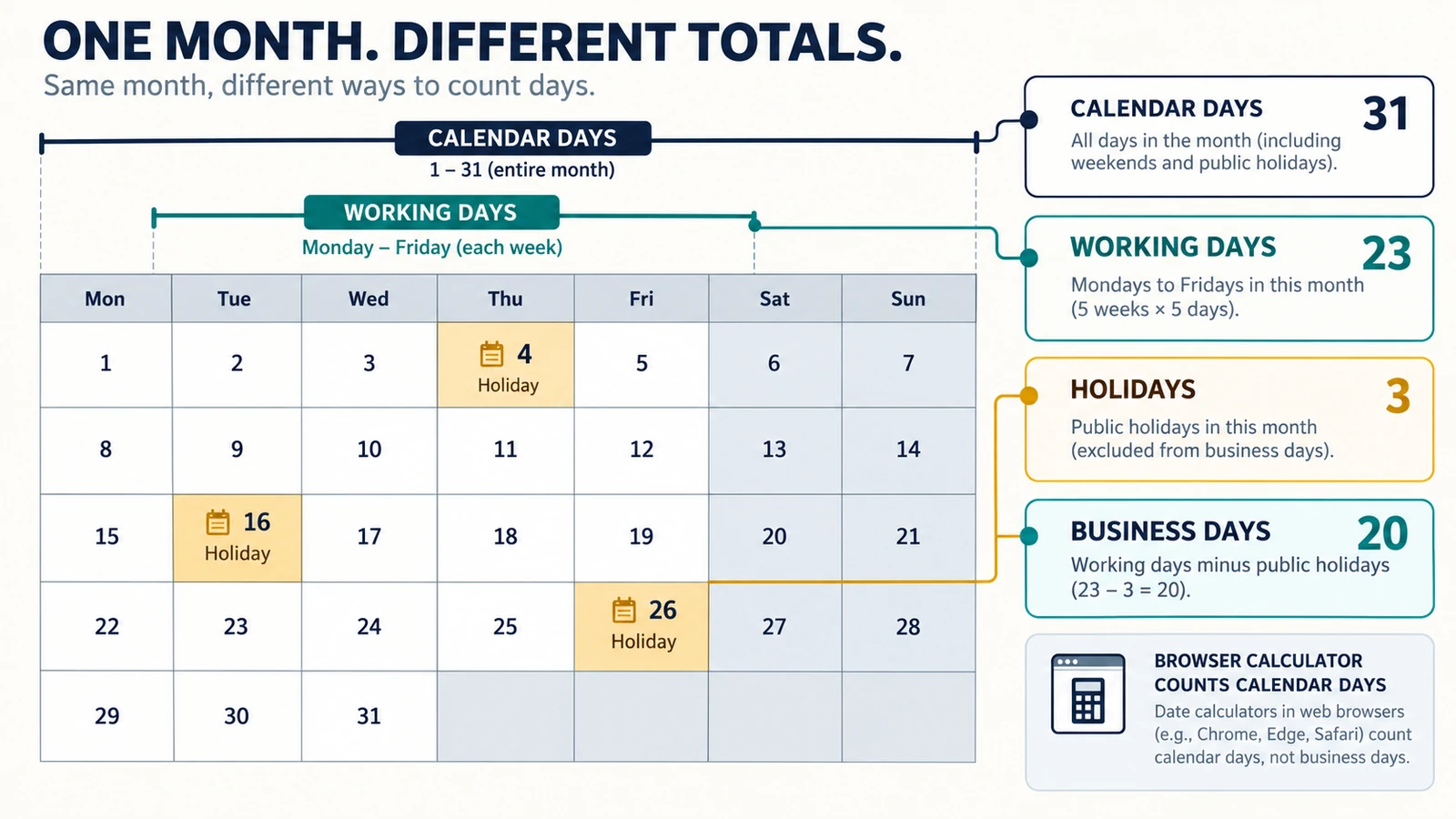
Calendar Days, Working Days and Business Days: What’s the Difference?
Understand the difference between calendar days, working days and business days, with simple examples and guidance on choosing the right date calculation.
Utilities & productivity Date & time Calculators Converters 4 min read
Published By Julia M. Gil
-
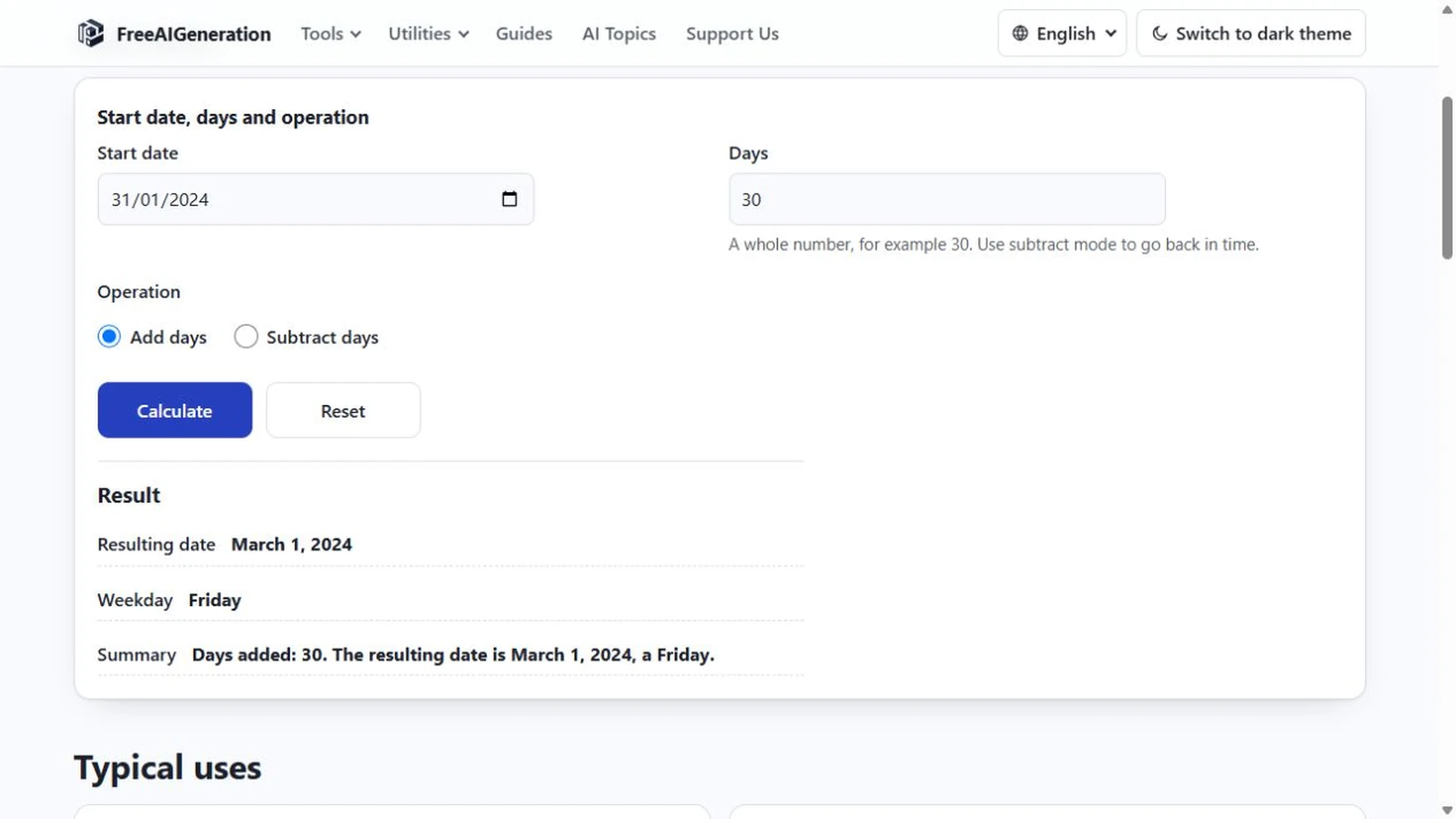
How to Add Days to a Date
Days and months are different units, and only the day count is fixed. Month ends, leap days, year turns, rejected input, plus the weekday of the answer.
Utilities & productivity Date & time Calculators Converters 4 min read
Published By Julia M. Gil
-
How to Calculate a Due Date from a Start Date
Calculate a future due date by adding a defined number of calendar days to a start date, with examples and common counting pitfalls.
Utilities & productivity Date & time Calculators Converters 3 min read
Published By Julia M. Gil
Keep exploring
FreeAIGeneration is more than this article. The editors and calculators below are real, free and run in your browser.