Calendar Days, Working Days and Business Days: What’s the Difference?
Understand the difference between calendar days, working days and business days, with simple examples and guidance on choosing the right date calculation.
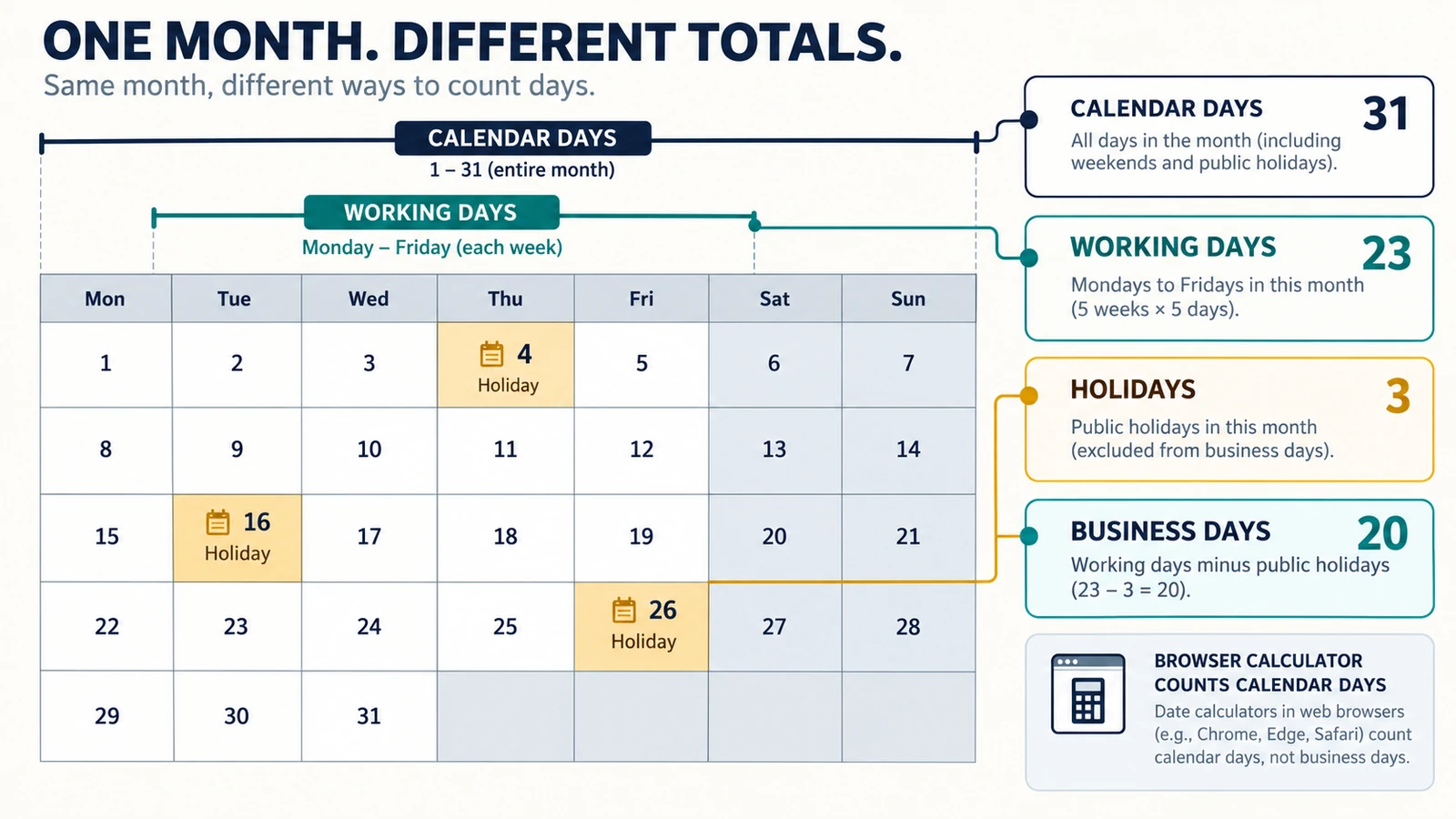
A contract says “30 days”. A bank says “30 business days”. The two clauses will not expire on the same morning, and the difference is not a rounding error. The calendar days vs working days question starts as vocabulary and ends as a scheduling decision.
All three phrases describe real measures of time. Only one is a pure property of the calendar; the other two depend on where you are and what the document says.
The three terms, defined as plainly as they allow
A calendar day is any date on the calendar, counted once. Nothing about it changes with your location, your employer or the season. Two dates define a fixed number of calendar days, and that number is the same for everyone.
A working day is a day on which work is normally done under a particular arrangement. Which days those are is a local fact: some arrangements treat Saturday as a working day, others do not, and some take Friday and Saturday as the weekend.
A business day is the term that appears most often in finance and administration. It usually means the days an institution is open for business, which may exclude weekends and public holidays, but the institution defines it, and different institutions define it differently.
In practice the three get used as synonyms, which is where the trouble starts.
Calendar days are the only portable measure
Calendar-day counting is arithmetic on dates: index the dates, subtract, and the answer does not depend on anyone’s rules. That portability is why a date calculator can be exact about this figure and silent about the others.
A calendar day also has nothing to do with hours: at a daylight-saving change a local day can run 23 or 25 hours, and the calendar count is unaffected because it never looks at a clock.
Working days and business days are local facts
Neither term has a single definition that travels. A working day can come from an employment contract, a collective agreement or a statute. A business day can come from a regulator, a stock exchange, a bank’s published terms or the wording of the clause you are reading.
Two details break even careful assumptions. The weekend is not Saturday and Sunday everywhere, so “the next working day” can mean different dates in different places. Public holidays are worse: many of them move to a substitute weekday when they fall at a weekend, so a published list and an observed list can disagree by a day.
Nothing in ISO 8601 settles this. The standard fixes how dates and durations are written; it does not define a business-day count, because the count is a legal and commercial convention rather than a format rule.
What the calculator does with those terms
The Days Between Dates Calculator counts calendar days. None of its four outputs counts working days, and the “Count both dates” checkbox changes which endpoints count, not which days are counted. It cannot exclude a weekend, skip a holiday or apply a working-day convention, and its own limits list says so. It runs in the browser tab and needs no FreeAIGeneration account.
That is not a missing switch. A tool that does not know your jurisdiction, your contract and your holiday calendar cannot honestly produce a working-day total; it can give you the calendar total that the other count starts from.
Doing the conversion yourself
The manual route is to count the calendar days, then remove the days your rule treats as non-working. In a 30-day period the two figures separate: the 30 calendar days from 2 January to 31 January 2024 contain 22 weekdays and 8 weekend days, and 22 + 8 = 30.
Thirty business days from Monday 1 January 2024, with no holiday in between, ends on Monday 12 February 2024: six whole working weeks, 30 ÷ 5 = 6, and six weeks is 42 calendar days.
If a document is the source of the deadline, the document’s own definition outranks any rule of thumb. A bare “30 days” is usually read as calendar days, but the clause, not the calculator, decides.
Choosing the right figure
Decide what the number is for. For a record of elapsed time, use calendar days, which need no local knowledge. For capacity between two dates, apply the working-day rule that governs the people doing the work, and state the rule beside the number so the next reader can check it.
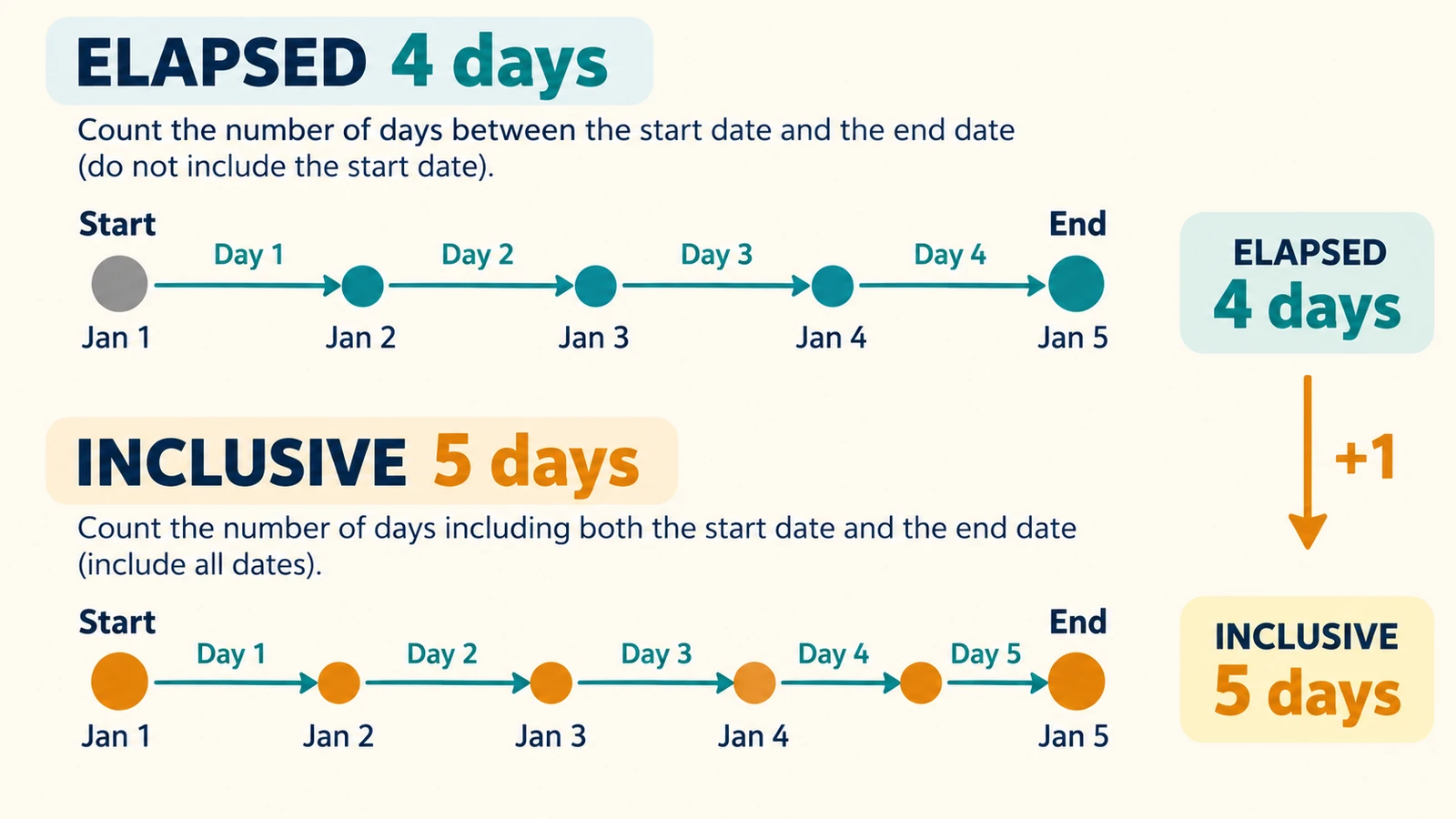
Either way the arithmetic starts in the same place: two dates and one subtraction. The guide to calculating the days between two dates walks through that subtraction, and the question of whether the start and end date should count settles the endpoints before any working-day rule comes in.
Frequently asked questions
Can the calculator count business days instead of calendar days?
No. All of its outputs count calendar days, and there is no option for weekends, public holidays or working-day conventions.
Are working days and business days the same thing?
Not necessarily. Both are defined by a contract, a statute or an institution's own rules, and the definitions can differ from each other and between places.
Why might two documents quote different day counts for one period?
One may be counting calendar days, the other only the days its rule treats as working days. The counts measure different things rather than contradicting each other.
Related articles
-
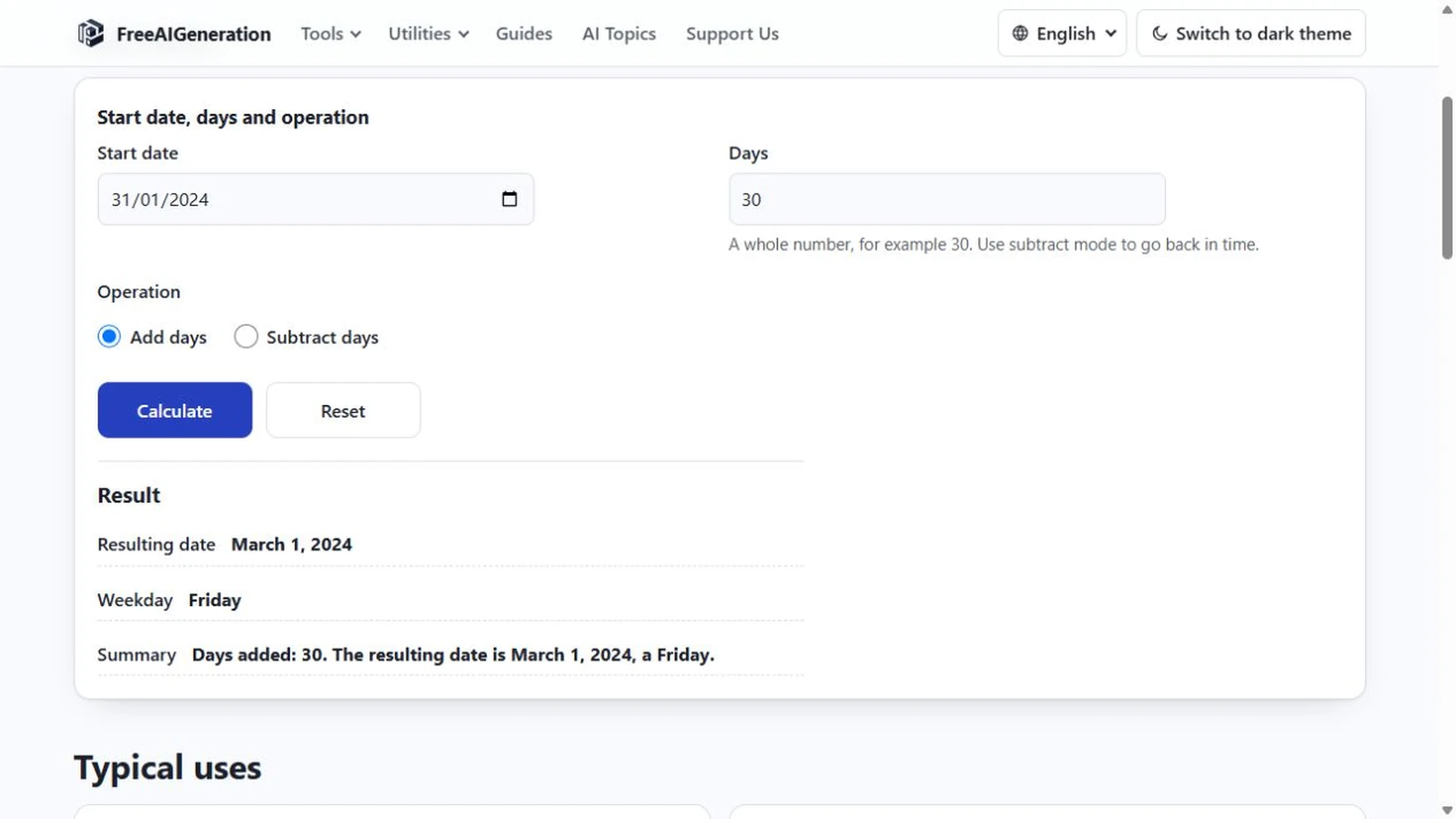
How to Add Days to a Date
Days and months are different units, and only the day count is fixed. Month ends, leap days, year turns, rejected input, plus the weekday of the answer.
Utilities & productivity Date & time Calculators Converters 4 min read
Published By Julia M. Gil
-
How to Calculate How Many Days Are Left Until a Date
Find how many days remain before a future date, event or deadline and verify the result with our date difference calculator.
Utilities & productivity Date & time Calculators Converters 3 min read
Published By Julia M. Gil
-
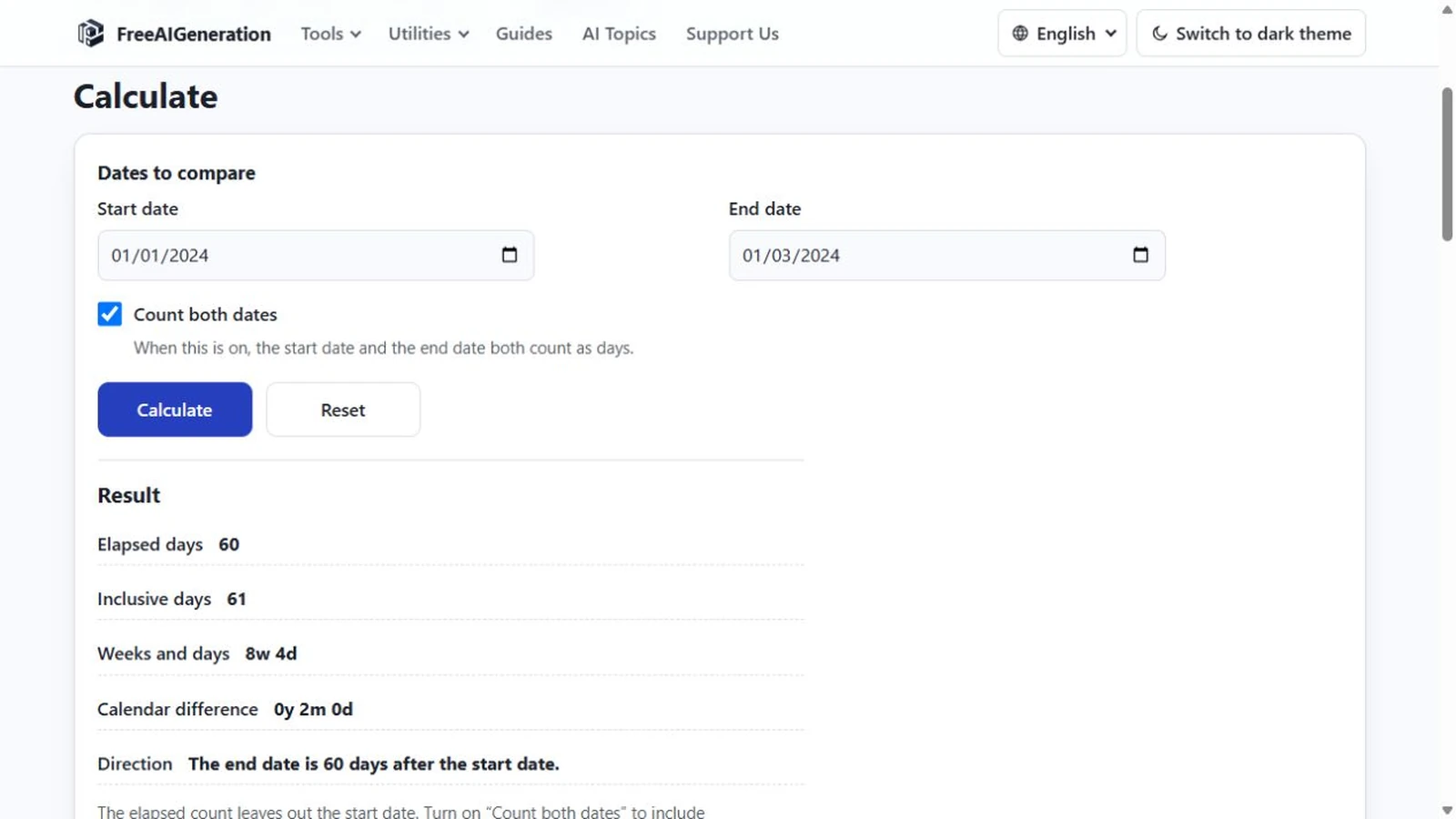
How to Calculate the Number of Days Between Two Dates
Two dates return four numbers: elapsed, inclusive, weeks and days, and calendar difference. Why they disagree, and which one a quoted figure was probably counting.
Utilities & productivity Date & time Calculators Converters 4 min read
Published By Julia M. Gil
Keep exploring
FreeAIGeneration is more than this article. The editors and calculators below are real, free and run in your browser.