Should You Count the Start and End Date?
See how inclusive and exclusive date counting changes the result, with clear examples for counting the first day, last day, or both.
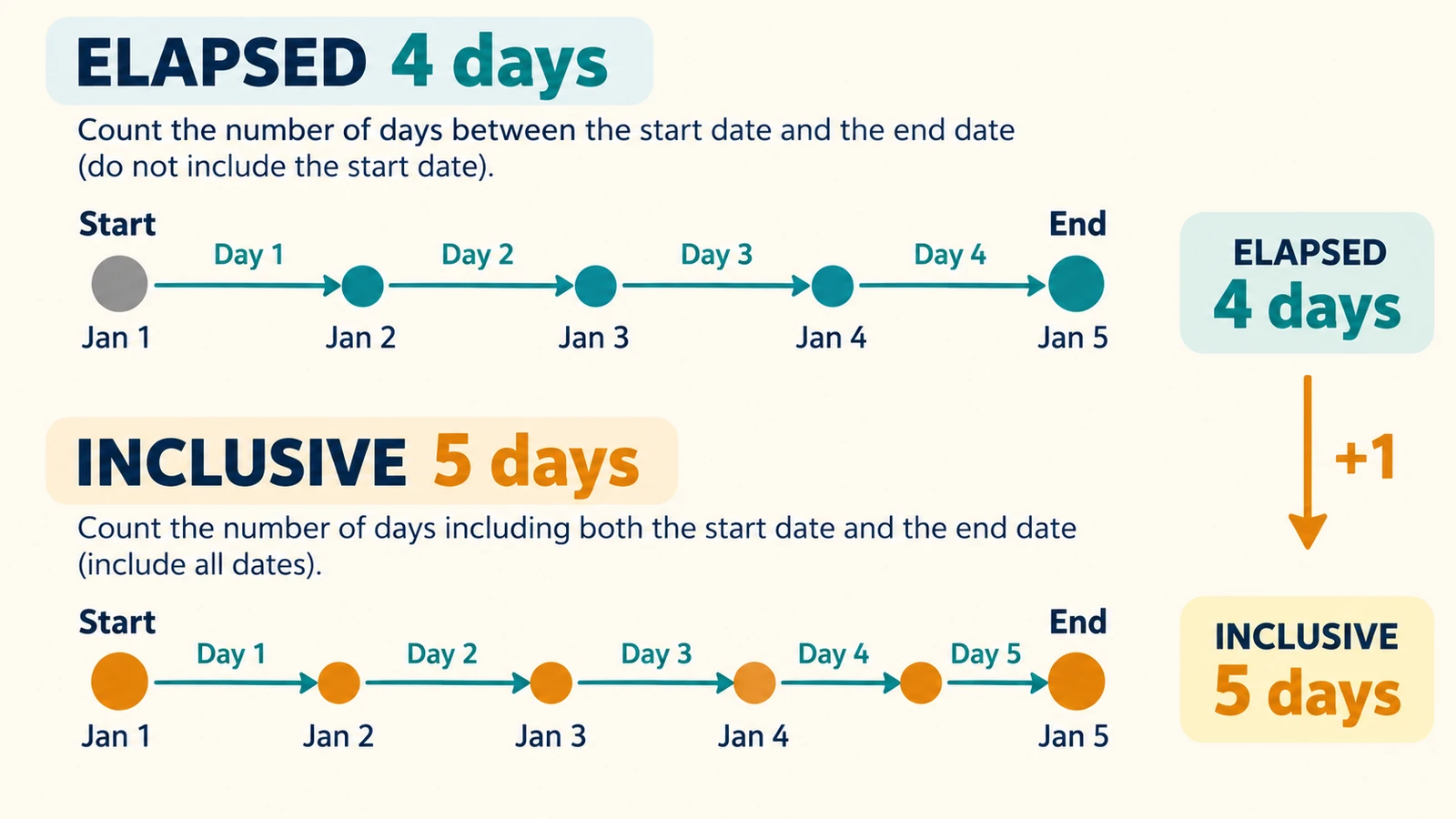
A fortnight can be thirteen days or fourteen, and both answers can be right. The difference is a single decision about whether to include start and end date in the total, or to measure only the space between them.
The calculator takes a default position on that decision, and it is worth knowing before you quote a number.
The default, stated once
Elapsed days means end minus start. The start date is excluded, the end date is included, and the total for 1 January to 2 January is one day. Enter the same date twice and the elapsed figure is zero, with a sentence saying the two dates are the same day.
Inclusive days means the same span with both endpoints counted, which is always exactly one more. That is the whole of the difference; there is no third convention hiding in the settings.
Both numbers for the same span
The “Count both dates” checkbox adds the inclusive row without altering the elapsed one. Tick it and you see what each convention would say for your pair of dates.
| Start | End | Elapsed | Inclusive |
|---|---|---|---|
| 2024-01-01 | 2024-01-02 | 1 | 2 |
| 2024-06-01 | 2024-06-30 | 29 | 30 |
| 2024-12-30 | 2025-01-02 | 3 | 4 |
Read the second row as the classic month question: June has 30 dates, but the gap from 1 June to 30 June is 29 days. The inclusive count is the one that equals “30 days in June”, and the elapsed count is the one that equals the space between the two dates.
Turning the toggle off does not exclude the end date
The common misreading is that unticking the box removes the last day. It does not. Elapsed counting already includes the end date; what it leaves out is the start. A span from 1 January to 2 January is one day under elapsed counting and two days under inclusive counting, and the end date contributes in both.
The other mistake is treating inclusive as a more generous or more accurate calculation. It is neither. It simply counts both endpoints, and it knows nothing extra about the calendar.
Telling which convention a quoted figure used
Numbers usually identify themselves. Compare a quoted count with the two dates it claims to describe: the plain difference between those dates is the elapsed figure, and one more than that is the inclusive figure.
Boundary cases make the check worth running. From 30 December to 2 January the elapsed count is 3 and the inclusive count is 4, which is the difference between “three nights” and “four dates touched”. From 1 July to 14 July the pair is 13 and 14. A document that quotes one of those numbers has told you its convention, whether or not it meant to.
Where the written date range is all you have, compute both figures and match the one in the source. Guessing from the wording alone is less reliable than comparing integers.
Where the extra day hides
Month and year boundaries hold most of the off-by-one cases, because the last day of one period and the first day of the next sit next to each other and get counted from both sides in ordinary speech. 31 December to 1 January is one elapsed day and two inclusive days. 31 January to 1 February behaves the same way. 28 February to 1 March 2024 is two elapsed days and three inclusive, because the leap day sits between them.
A single date is the smallest case: zero elapsed, one inclusive. If a form asks how many days a single date represents, the inclusive answer is the one it wants.
Settling it in the browser
Enter the two dates in the Days Between Dates Calculator with “Count both dates” on, and both conventions appear together. That comparison is usually enough to reconcile a figure you were given with the dates you were given.
The page runs in the browser tab, needs no FreeAIGeneration account, and stores nothing between visits.
The mechanics behind the two rows are set out in the guide to calculating the days between two dates, and the units question — when days, weeks or months are the honest answer — belongs to the piece on durations in days, weeks and months.
Frequently asked questions
Does unticking "Count both dates" remove the end date?
No. The elapsed count always includes the end date and excludes the start date; the checkbox only controls whether the inclusive row is displayed.
What is the inclusive count for a single date?
One. The same date entered twice gives zero elapsed days and one inclusive day, because that one calendar date is counted once.
Is one of the two conventions more standard?
No. Both are conventions; ISO 8601 standardises how dates and durations are written but prescribes no count for the difference between two dates.
Related articles
-
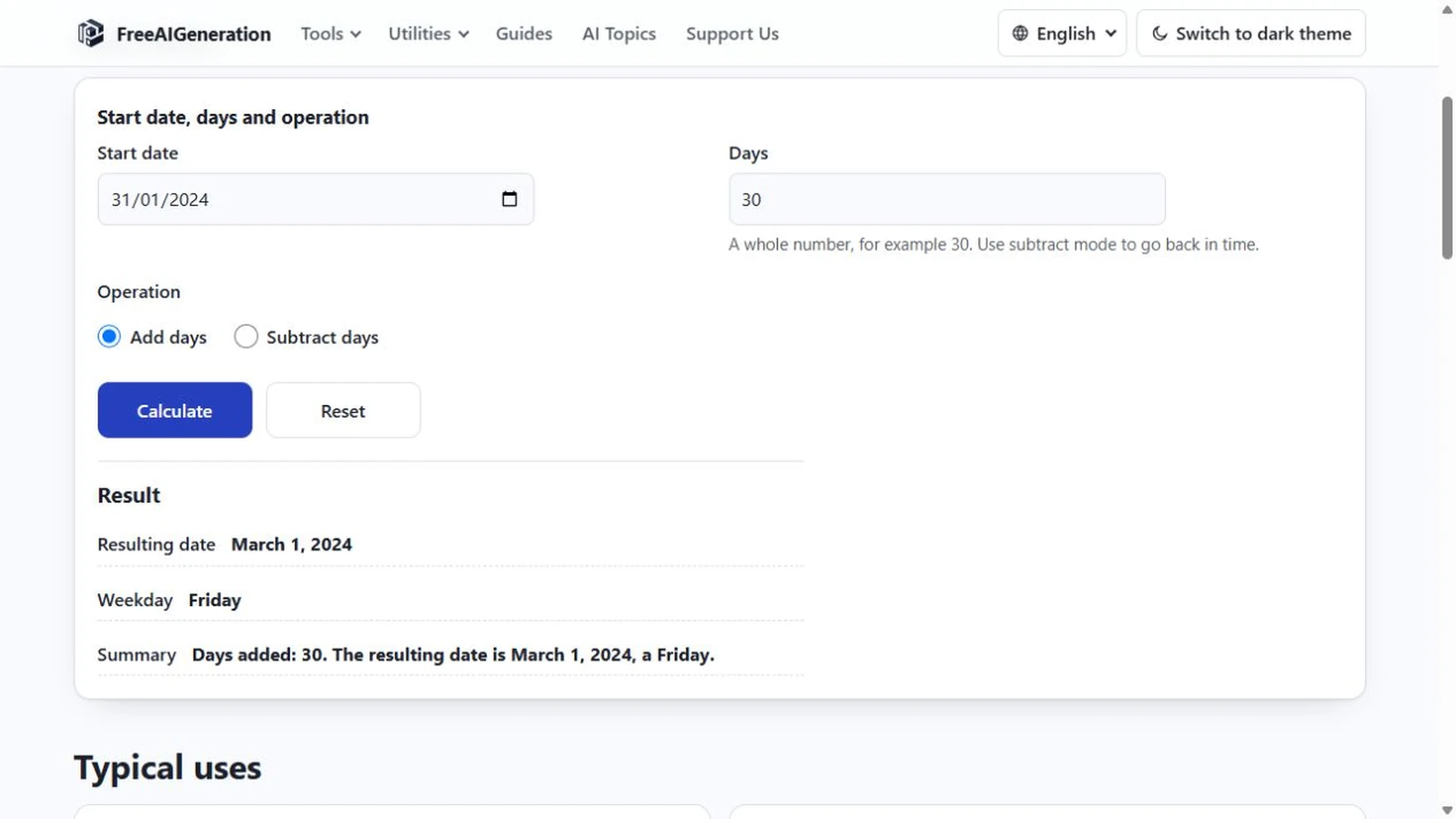
How to Add Days to a Date
Days and months are different units, and only the day count is fixed. Month ends, leap days, year turns, rejected input, plus the weekday of the answer.
Utilities & productivity Date & time Calculators Converters 4 min read
Published By Julia M. Gil
-
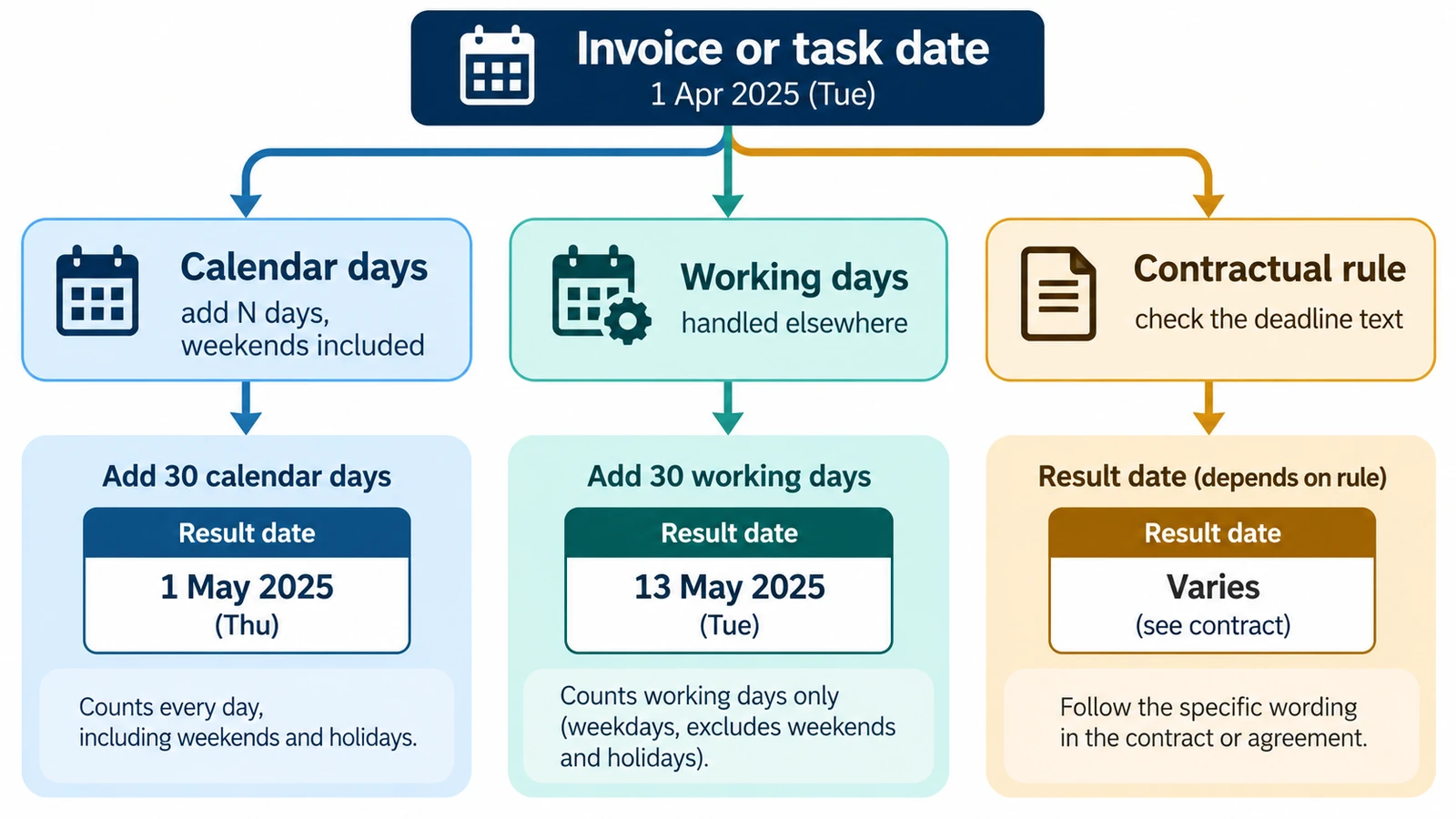
How to Calculate a Due Date from a Start Date
Calculate a future due date by adding a defined number of calendar days to a start date, with examples and common counting pitfalls.
Utilities & productivity Date & time Calculators Converters 3 min read
Published By Julia M. Gil
-
How to Calculate How Many Days Are Left Until a Date
Find how many days remain before a future date, event or deadline and verify the result with our date difference calculator.
Utilities & productivity Date & time Calculators Converters 3 min read
Published By Julia M. Gil
Keep exploring
FreeAIGeneration is more than this article. The editors and calculators below are real, free and run in your browser.